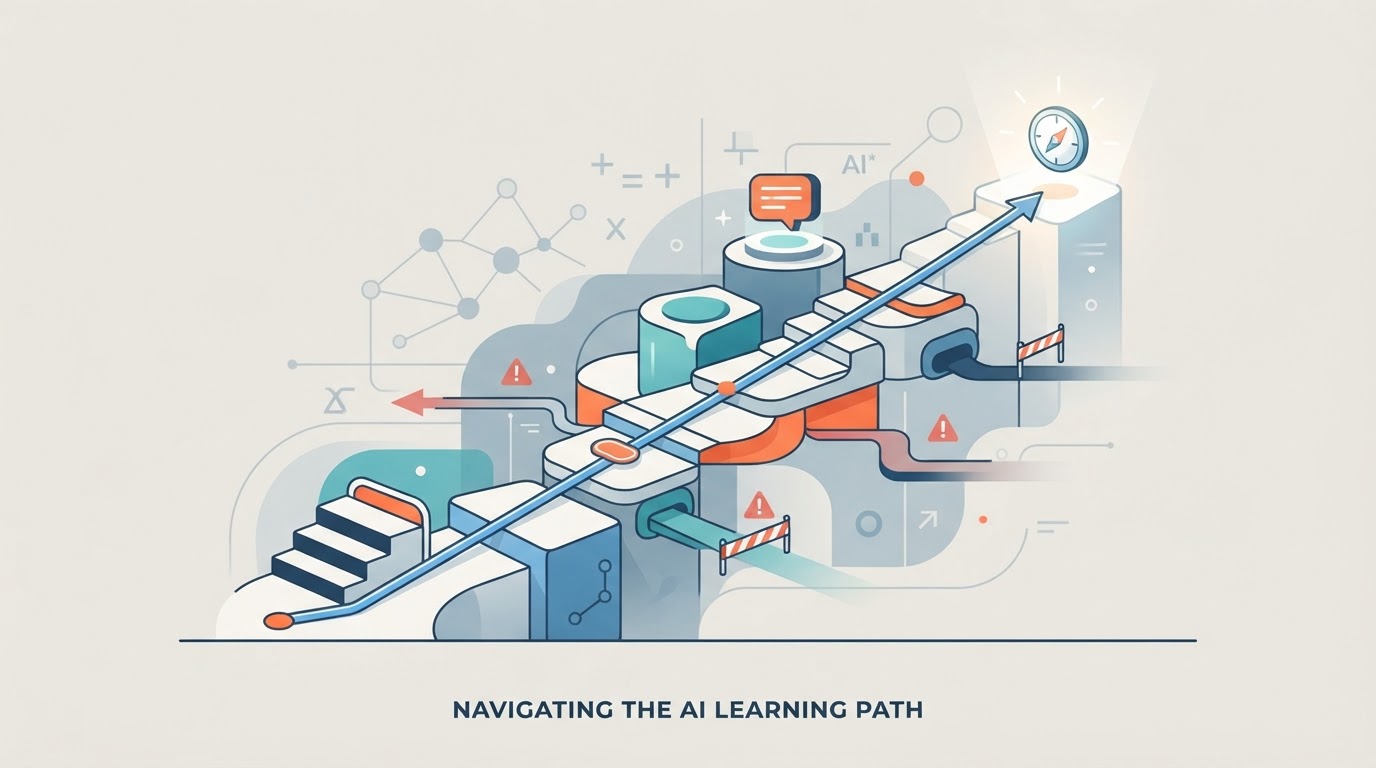
Learning AI Mistakes to Avoid: A Beginner's Guide
Introduction
Embarking on artificial intelligence education can feel overwhelming. By learning AI mistakes to avoid early on, you can streamline your progress and build a solid foundation for long-term success.
Skipping the Fundamentals and Math
Warning: Bypassing core concepts stalls progress.
When applying beginner machine learning tips, rushing straight to advanced coding without grasping foundational theories creates massive knowledge gaps. Master the basics first to truly understand how algorithms function.
Ignoring Linear Algebra and Calculus
Warning: Skipping vector spaces and derivatives halts growth.
Neglecting calculus prevents you from understanding gradient descent. Master these mathematical essentials to properly optimize your artificial intelligence education and coding logic.
Rushing Straight into Complex Models
Warning: Jumping directly into deep neural networks causes debugging nightmares.
When designing your ai roadmap for beginners, trying to build transformer models before understanding simple regression leads to confusion. Start small and scale up gradually.
Neglecting Core Statistics Concepts
Warning: Ignoring probability distributions and hypothesis testing limits your ability to evaluate model performance effectively.
When mastering beginner machine learning tips, remember that data interpretation requires variance and mean analysis to prevent overfitting.
Following a Flawed AI Roadmap
Warning: Adopting a disorganized learning machine learning pitfalls strategy wastes countless hours on irrelevant tutorials.
Many beginners wander aimlessly across random topics instead of following a proven, step-by-step strategy for sustainable skill development.
Lack of a Structured Learning Path
Warning: Randomly picking up disjointed topics is one of the top learning ai mistakes to avoid.
Without a clear progression, you will easily fall into learning machine learning pitfalls that stunt your overall technical growth.
Tutorial Hell and Endless Watching
Warning: Consuming endless video tutorials without writing code keeps you trapped in passive learning.
How to start with ai effectively requires active coding rather than endless viewing. Build actual programs to truly retain concepts.
Failing to Build Real-World Projects
Warning: Relying solely on synthetic datasets prevents you from handling messy production data.
Applying beginner machine learning tips means solving chaotic, real-world problems to genuinely master how to start with ai.
Mismanaging Machine Learning Tools
Warning: Relying on bloated environments stalls productivity.
Proper setup prevents common AI programming errors. Master your core software stack early to avoid debugging broken dependencies instead of writing actual algorithms.
Over-Reliance on Pre-built Libraries
Warning: Relying exclusively on high-level frameworks blinds you to how algorithms function under the hood.
When learning machine learning pitfalls, pasting generic functions prevents you from debugging custom AI programming errors effectively. Understand raw implementations first.
Ignoring Data Quality and Preparation
Warning: Feeding dirty datasets into algorithms guarantees flawed predictions.
Mastering how to start with ai requires meticulous data cleaning. Neglecting this crucial preparation step leads to the ultimate learning machine learning pitfalls, ruining model accuracy.
Poor Version Control and Experiment Tracking
Warning: Overwriting model weights without tracking parameters leads to unrepeatable results.
When learning machine learning pitfalls, failing to log hyperparameters and dataset versions makes debugging impossible. Use tools like Git and MLflow to maintain reproducible experiments and avoid common AI programming errors.
Conclusion
Mastering artificial intelligence requires patience, disciplined planning, and rigorous execution. By steering clear of these frequent setbacks and sticking to a deliberate timeline, you will build robust skills and accelerate your technical growth.
Frequently Asked Questions
What are the biggest mistakes beginners make when learning AI?
The biggest misstep is rushing into advanced deep learning before understanding the basics. Many students also fall into passive content consumption, which stalls real progress.
Warning: Skipping core mathematical concepts makes debugging complex models nearly impossible later on.
Do I need strong math skills to start learning artificial intelligence?
You do not need a Ph.D. in mathematics to begin your journey. However, you do need a working grasp of specific branches to interpret model behaviors accurately.
| Mathematical Area | Primary Application in AI |
|---|---|
| Linear Algebra | Handling multi-dimensional arrays and matrix transformations |
| Calculus | Optimizing weights using gradient descent |
| Statistics | Evaluating model accuracy and managing variance |
How can I avoid getting stuck in tutorial hell while studying machine learning?
The best way to break the cycle of endless watching is the 50/50 rule. Spend half your time on theory and the other half building independent projects from scratch.
Pro Tip: Force yourself to modify existing code scripts to see how breaking parameters affects the final output.
What is the best ai roadmap for beginners starting from scratch?
A reliable progression begins with fundamental programming, moves through basic algebra and statistics, and then introduces supervised algorithms. Only after mastering those milestones should you tackle neural networks.
How long does it take to become proficient in basic AI concepts?
Most dedicated learners need about six to twelve months of consistent daily practice. True proficiency depends heavily on active coding hours rather than calendar months elapsed.
Should I learn Python before starting any machine learning projects?
Yes, mastering a flexible language like Python is essential because of its rich ecosystem of data science libraries. Familiarity with syntax allows you to focus on logic rather than fighting syntax errors.
Leave a Reply